
Body Clock & Rhythm
Train With Your Body’s Natural Rhythm
When timing aligns, performance follows.

Training isn’t just about effort—it’s about syncing with your body’s internal clock. Beneath every workout is a natural rhythm guiding your energy, recovery, focus, and output. When you align your routine with this rhythm, consistency feels effortless and performance becomes sustainable.
Philosophy
True development doesn’t come from intensity alone—
it comes from harmony.
When training, rest, breath, and sleep follow a natural rhythm,
your body adapts more deeply—with less resistance.
Transition
This is where training shifts:
From effort… to flow.
Training Process
Why Rhythm Matters
Modern life pulls you in every direction.
- Sleep becomes inconsistent
- Meals become irregular
- Training happens “when there’s time”
And slowly, the body loses its sense of timing.
What Happens Without Rhythm
- Energy becomes unpredictable
- The mind becomes restless
- Fatigue lingers
Because the body doesn’t thrive in chaos— it thrives in rhythm.
What Rhythm Creates
When rhythm is restored:
- The body adapts faster
- Breathing becomes steady
- Energy stabilizes
- Sleep improves
- Training becomes more effective
Deeper Effect
Rhythm creates internal order— a quiet stability in body and mind.
Over time, it becomes more powerful than
any single session.
Because it becomes the pattern your life
moves through.
BALANCE DEVELOPS
The Body Clock
Your body follows an internal rhythm—
guiding when you have energy, when you focus best,
and when you need recovery.

The Problem
Most people ignore this.
- They push when tired
- They rest when ready to move
- They work against their biology
This creates unnecessary resistance.
The Shift
When you align with your body’s timing
- Movement feels smoother
- Energy is used efficiently
- Recovery deepens
You stop forcing progress
— and start allowing it.
Daily Rhythm Overview

Morning
Calm, foundation, breathing
Midday
Movement, strength, active training
Evening
Stretching, calming, recovery
Night
Rest and
restoration
Core Insight
It’s not about doing more—
it’s about doing what is aligned.
Different times of day require
different qualities.
Result
Less effort—deeper results.
Because you respond to your body,
instead of forcing it.
-
MORNING PRACTICE
-
Morning Practice — Building the Foundation
The morning holds a unique quality.In traditional understanding, this is when Yang Qi—the active, rising energy of the body—is beginning to grow.
It is the moment of transition… from stillness into movement, from rest into action.And this makes it one of the most powerful times to train.
Not because the body is at its peak— but because it is not.- The body is still stiff.
- The mind is still quiet.
- The breath is more accessible, less influenced by the noise of the day.
And this is exactly why morning practice is so valuable.It is the ideal time to build the foundation.
- To gently awaken the body.
- To align your structure.
- To establish your breathing.
- To set the tone for how you will move through the day.
A simple morning practice may include:- Standing practice—to ground and align.
- Breathing exercises—to regulate and center.
- Slow movements—to connect body and mind.
- Light stretching—to release stiffness.
- Basic stepping—to activate coordination.
Nothing aggressive. Nothing excessive.
Because morning training is not about exhausting yourself — it is about preparing yourself.
And even 10–20 minutes, done with awareness and consistency, can create a powerful shift.
You don’t just wake up your body.You set your direction.
For how you move.
How you breathe.
How you meet the day ahead. -
MIDDAY ACTIVITY
-
Midday Practice — Expression & Application
Midday carries a different energy.- This is when Yang Qi is at its peak—fully risen, active, expansive.
- The body is warmer.
- The joints are more open.
- Energy is more available.
Where morning is about building the foundation, midday is about expressing it.This is the time when your training can become more dynamic, more physical, more demanding.- It’s where structure is tested in movement.
- Where breathing is challenged under effort.
- Where coordination, strength, and adaptability come alive.
Midday practice may include:
- Forms practice—integrating movement and flow.
- Strength training—building physical capacity.
- Partner work—applying structure under pressure.
- Longer sessions—going deeper into the practice.
- Or even physical work and daily activity.
Because at this stage, something important begins to shift:
Training is no longer separate from life.
Even if you are not in a formal session, how you stand, how you sit, how you move, how you breathe during your work — this is your practice.
Midday teaches you how to use your body in the real world.This is where Yang energy is not just cultivated — it is applied.
And when used correctly, it doesn’t lead to exhaustion.
It leads to efficiency.
To power without tension.
To effort that feels natural, not forced.Because true mastery is not only in how you train—
but in how you use what you’ve trained, moment by moment, throughout your day. -
EVENING PRACTICE
-
Evening Practice — Recovery & Return
As the day comes to a close, the energy within the body begins to shift.Yang Qi—the active, outward energy—gradually declines.
Yin Qi—the inward, restorative energy—begins to rise.This is the body’s natural movement toward rest, repair, and regeneration.Evening practice is about supporting this transition.- Not pushing
- Not stimulating
- But guiding the body back to balance.
After a day of activity, effort, and mental engagement, this is your opportunity to release what you’ve accumulated.- To soften tension.
- To quiet the mind.
- To return inward.
A simple evening practice may include:- Stretching—to release physical tightness.
- Slow, mindful movement—to unwind the body.
- Breathing exercises—to regulate and calm the system.
- Quiet standing—to settle awareness.
- Meditation—to create mental stillness.
And as you move through this, something begins to shift.
- The nervous system downregulates.
- The breath deepens.
- The body lets go.
You don’t carry the weight of the day into the night.You dissolve it.Even a short evening practice can profoundly affect how you recover — and how deeply you sleep.
Because true progress is not only built during effort.
It is integrated during recovery.And when you learn to honor this Yin phase — your training becomes more complete, more sustainable, and far more powerful over time.
Morning Practice — Building the Foundation
In traditional understanding, this is when Yang Qi—the active, rising energy of the body—is beginning to grow.
It is the moment of transition… from stillness into movement, from rest into action.
And this makes it one of the most powerful times to train.
- The body is still stiff.
- The mind is still quiet.
- The breath is more accessible, less influenced by the noise of the day.
It is the ideal time to build the foundation.
- To gently awaken the body.
- To align your structure.
- To establish your breathing.
- To set the tone for how you will move through the day.
- Standing practice—to ground and align.
- Breathing exercises—to regulate and center.
- Slow movements—to connect body and mind.
- Light stretching—to release stiffness.
- Basic stepping—to activate coordination.
Nothing aggressive. Nothing excessive.
Because morning training is not about exhausting yourself — it is about preparing yourself.
And even 10–20 minutes, done with awareness and consistency, can create a powerful shift.
You don’t just wake up your body.
You set your direction.
For how you move.
How you breathe.
How you meet the day ahead.
Midday Practice — Expression & Application
- This is when Yang Qi is at its peak—fully risen, active, expansive.
- The body is warmer.
- The joints are more open.
- Energy is more available.
- It’s where structure is tested in movement.
- Where breathing is challenged under effort.
- Where coordination, strength, and adaptability come alive.
Midday practice may include:
- Forms practice—integrating movement and flow.
- Strength training—building physical capacity.
- Partner work—applying structure under pressure.
- Longer sessions—going deeper into the practice.
- Or even physical work and daily activity.
Because at this stage, something important begins to shift:
Training is no longer separate from life.
Even if you are not in a formal session, how you stand, how you sit, how you move, how you breathe during your work — this is your practice.
Midday teaches you how to use your body in the real world.
This is where Yang energy is not just cultivated — it is applied.
And when used correctly, it doesn’t lead to exhaustion.
It leads to efficiency.
To power without tension.
To effort that feels natural, not forced.
Because true mastery is not only in how you train—
but in how you use what you’ve trained, moment by moment, throughout your day.
Evening Practice — Recovery & Return
Yang Qi—the active, outward energy—gradually declines.
Yin Qi—the inward, restorative energy—begins to rise.
- Not pushing
- Not stimulating
- But guiding the body back to balance.
- To soften tension.
- To quiet the mind.
- To return inward.
- Stretching—to release physical tightness.
- Slow, mindful movement—to unwind the body.
- Breathing exercises—to regulate and calm the system.
- Quiet standing—to settle awareness.
- Meditation—to create mental stillness.
And as you move through this, something begins to shift.
- The nervous system downregulates.
- The breath deepens.
- The body lets go.
Even a short evening practice can profoundly affect how you recover — and how deeply you sleep.
Because true progress is not only built during effort.
It is integrated during recovery.
Impact
You don’t just start the day—you set the day.
Even a few minutes of You don’t just wake up your body—you set your direction for the day:practice shapes everything that follows.
How you move.
How you respond.
How you breathe.
How you respond.
RECOVERY & SLEEP
Recovery where growth
happens


Yin & Yang
-
Training = Yang (active,
demanding) -
Recovery = Yin (restorative,
essential)
Without recovery, progress slows.
What True Recovery Includes
- Consistent sleep
- Proper nourishment
- Stretching
- Calm breathing
- Rest days




Core Truth
-
You don’t improve only when
you train—
you improve when your body adapts.
Result
When Yin and Yang are balanced:
- Energy restores
- Strength rebuilds
- Progress becomes sustainable
Weekly Rhythm — Balancing Yin & Yang
Your week has rhythm too.
Why It Works
- The body improves without breaking
- Energy remains stable
- Motivation stays consistent
Progress is not built through intensity alone—
but through rhythm.
Suggested Structure
Daily short practice — consistency
2–3 longer sessions — challenge (Yang)
1 light day — refinement (Yin)
1 rest day — recovery (Yin)

Seasonal Rhythm — Training with Nature
Training is influenced by seasons.
Your body follows the same cycles as nature.
Why It Works
- Prevents overtraining
- Reduces injury
- Maintains long-term energy
Mastery is not constant effort—
it is knowing when to expand and when to return inward.
Suggested Structure
Winter (Yin)
Inward focus, foundation, conservation
Spring (Rising Yang) Movement, expansion, reconnection
Summer (Yang Peak) Intensity, endurance, expression
Autumn (Returning Yin) Refinement, control, preparation
Train With the Right
Rhythm
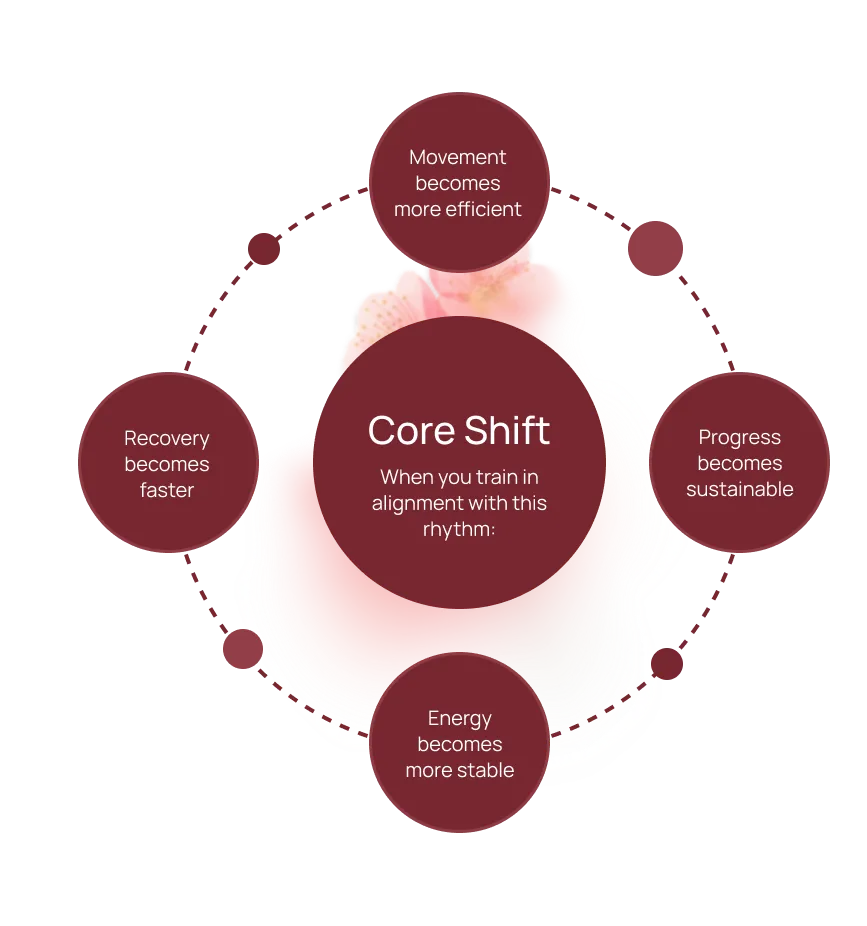
Progress becomes steady Energy becomes reliable Growth becomes sustainable
Yang → effort, movement, challenge Yin →
recovery, absorption, growth